
Coming through with the second installment of our series we have Mother. Mother (2009) is a 2009 South Korean crime drama directed by Bong Joon-ho. Starring actors Kim Hye-ja and Won Bin. The plot of the film centers around a mother and her disabled son, who is accused of the murder of a young girl. The mother attempts to find the real killer, to free her son. The film premiered on 16 May 2009 at the Cannes Film Festival in the Un Certain Regard section and was released in South Korea on May 28, 2009. The film follows the unnamed mother, who is a widow. She lives alone in a small town in South Korea. She lives with her son, Yoon Do-joon, who has an intellectual disability. She leads a modest lifestyle selling medicinal herbs and conducting unlicensed acupuncture treatments for the town’s women. The film later follows the crisis the mother goes through to release her helpless son.
This film is filled with various nuances and messages throughout, yet one of the prevalent ideas is about ‘Concealment’. Looking at Mother (2009), the film starts with an elderly woman on a field and she is directly looking into the camera and dancing along to an eerie and rhythmic tune. As she dances it seems mesmerizing, yet unnerving. She covers her mouth and eyes briefly in her enchanting dance. Finally, as the title comes onto the screen, she isn’t dancing anymore and looks directly into the camera as she moves one of her hands into her coat as if she is hiding something. The movie starts with a sense of only a certain portion of the picture is being shown. As the film progresses through with the plot showing various instances of deceptive stances. Right in the beginning as Do-joon’s friend Jin-tae blames him for breaking a side view mirror of a car and while it was Jin-tae himself that did it, the film starts on a set of lies being told. Which then proceeds to Jin-tae throwing an expensive golf club into a lake, when fighting with some men at a golf park. Just to go steal the golf club later. As the film progresses, Do-joon is framed for a murder, and the police officers investigating the case just want to close the case and see the fact that Do-joon having a disability as an easy exit. The film progresses to show a story, yet it always feels like something is hidden or the characters are hiding something from the audience. A titular moment within the film is when Do-joon is told by his mother to try and remember the events of the day he saw the murdered girl, so that she can prove her son’s innocence. Do-joon unfortunately remembers an incident from his childhood where his mother tried to kill him by giving him an insecticide. Yet, he does not remember the whole story as his mother was trying to both of them because they were not being able to get by and their life becoming miserable by the day. The incomplete nature of the story adds to the idea of deception, as the audience draws one conclusion it turns out to be another. Finally, with the big reveal of Do-joon being the person who murdered the girl, not with malicious intent yet he did murder her. Once the truth is revealed to the audience, the story turns around in his favor and he is let free and another individual going through circumstances much like Do-joon himself is convicted.
Director Bon Joon-ho represents this message clearly with various elements such as using a 2.35:1 size frame for the shots to create a larger picture and conceal details we might not catch on to. Character shots have various parts of the character cut out such as the forehead or the chin or the characters are hiding behind things such as doors, walls, or curtains. Yet, one thing that remains consistent is the eyes. Bong Joon-ho also brings in heavy detail the concept of a mother. A mother’s love is a force mostly taken granted for, yet the power it holds is unfathomable. by casting Kim Hye-ja who is known popularly to play mother figures in films, Bong Joon-ho represents the idea of the other and the mother’s love for her child as a consistent element within the film (Mother is bong joon-ho’s Masterpiece (spoiler for Parasite) 2020). Even though, deception creeps its way through the film, our protagonist’s love for her son is the only truth within the film. In the end when the mother visits the boy finally convicted for her son’s crime she sees that the boy also has a disability and has nothing to his name. She asks the oy whether he has parents and the boy says no, which makes her cry out loud for the boy as she sees her son in this boy yet he has no one to fight for his freedom as she fought for her son’s. Therefore concealment also works in helping her rid herself of the shame and guilt for her selfishness and love.
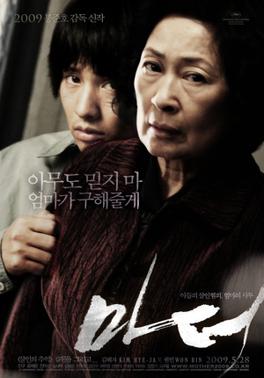
Poster for Mother (2009) 
Mother in the open field at the start of the film 
Wide shot of Do-joon covering his eye, only remembering half the story. 
Wide shot of the girl who gets murdered later from the view point of Do-joon.
References
Mother is bong joon-ho’s Masterpiece (spoiler for Parasite) [Video file]. (2020, February 29). Retrieved April 24, 2021, from https://youtu.be/iT08OXSSZxo
B., G. (2020, April 08). Bong joon-ho’s “MOTHER” (presented by 10 years ago: Films in Retrospective). Retrieved April 24, 2021, from https://filmwonk.net/2020/03/13/bong-joon-hos-mother-presented-by-10-years-ago-films-in-retrospective/
Posted by In the Realm of the Lenses 2020-12-01, & In the Realm of the Lenses. (n.d.). Visualizing maternal love And Desperation: 8 shots from bong Joon-ho’s “Mother” (2009). Retrieved April 24, 2021, from https://www.newsbreak.com/news/2102706727430/visualizing-maternal-love-and-desperation-8-shots-from-bong-joon-hos-mother-2009
 Cinema of the Wave