
With the fourth film in this series, we are looking at Kim Jee-woon’s 2008 South Korean Western action film starring Song Kang-ho, Lee Byung-hun, and Jung Woo-sung. The film was premiered at the 2008 Cannes Film Festival and had a limited release in the U.S. on April 23, 2010. The film The Good, the Bad, the Weird (Also known as 좋은 놈, 나쁜 놈, 이상한 놈; Jo-eun nom nappeun nom isanghan nom) garnered praise and recognition over the action, the cinematography and the direction.
With the name being similar to the infamous 1966 Western The Good, the bad and the Ugly directed by Sergio Leone, Jee-woon’s display of the traditional Western is undoubtable Korean in its approach. Highlighting Korean sentiment and issues in the style of a Spaghetti Western. The Good, the Bad, the Weird is noted as one of he most expensive South Korean films with a reported $17 million into the two years of production. This film is also representative of the South Korean tech expertise and ambition, along with the first release of the K-oater subgenre as it is not the first “oriental Western” as stated in the closing credits of the film. The film contains various references to The good, the Bad and the Ugly, with the idea of the central trio to begin with. The character of “the Bad”, being a black suited and spiky haired revered bandit leader called Park Chag-yi (Lee Byung-hun), who’s hired by a business man who is pro-Japanese during the time period of the Japanese imperial rule in Korea. Along with the character of “the Weird” who is a comical and simple train thief called Yoon Tae-gu (Song Kang-ho). Finally on screen is the character of “the Good” Park Do-won played by Jung Woo-sung, a lone wolf bounty hunter who is out for Chang-yi. The film follows these three characters and their chase to find a treasure situated in Manchuria. The film also contains a traditional standoff, similar to the original Mexican standoff (Elley, 2008).
The Good, the Bad, the Weird is a clear example of a transnational cinematic understanding. Drawing from traditional Hollywood styles and embedding it with Korean sentiments and emotions. It takes in a great deal of inspiration from the spaghetti western genre and was marketed as a “kimchi” western to appeal to a domestic and international audience. The film doesn’t blatantly imitate Hollywood narratives, rather it uses these narratives to its advantage. The Good, the Bad, the Weird understands the western narrative and places traditionally Korean feelings such as the Japanese Imperial rule in Korea. The Japanese Imperial rule stands as significant marker in Korea’s history within the nation and the national identity. Jee-won plays with the concept of genre intertextuality through the film and highlights the fact that the film addresses various audiences (Cho, 2015).
The film is a key example of transnational Korean cinema. The idea of transnational cinema is a consistent factor within Korean cinema. Being the start to the kimchi western, various Asian cinematic endeavors with reference to westerns have taken place post the release of The Good, the Bad, the Weird.
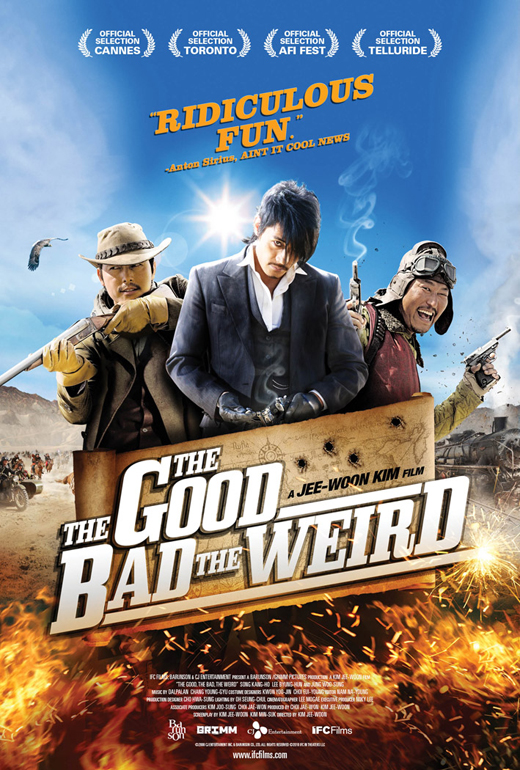
The poster of the film 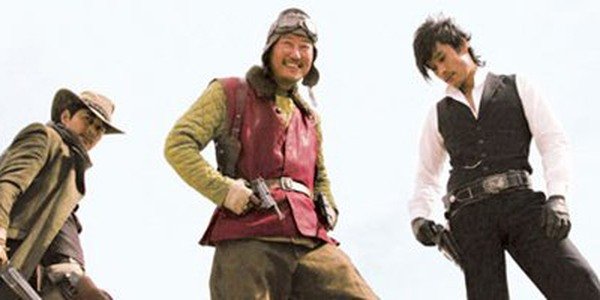
From left to right: The Good- Park Do-won (Jung Woo-sung), the Weird-Yoon Tae-gu (Song Kang -ho) and the Bad- Park Chang-yi ( Lee Byung-hun). 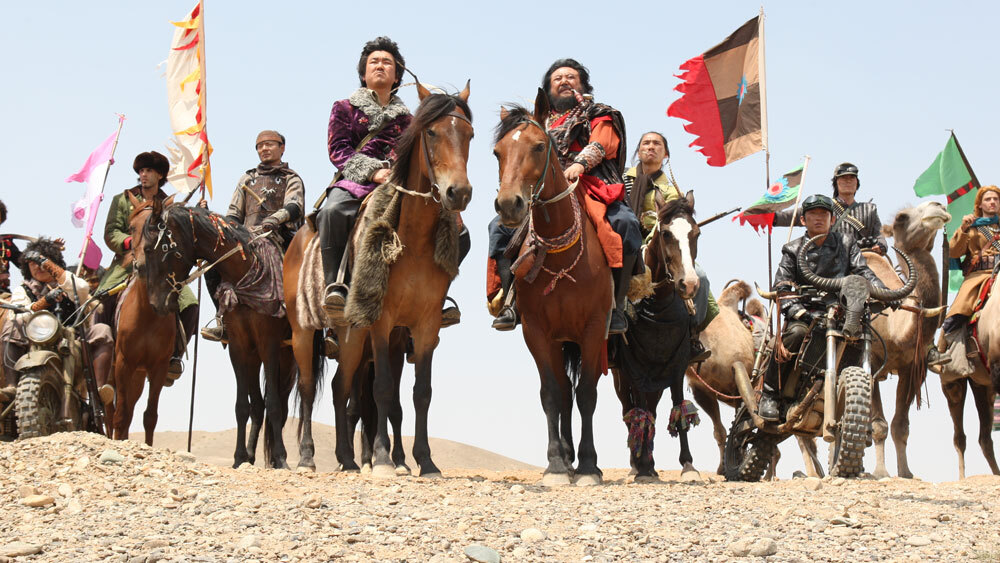
Park Chang-yi’s subordinate bandits along with the members of the ghost market .
References
Cho, M. (2015). Genre, Translation, and Transnational Cinema: Kim Jee-woon’s The Good, the Bad, the Weird. Cinema Journal, 54(3), 44–68. https://doi.org/10.1353/cj.2015.0022
Elley, D. (2008, May 24). The good the bad the weird. Retrieved May 20, 2021, from https://variety.com/2008/film/markets-festivals/the-good-the-bad-the-weird-1200522089/
Holcomb, R. (2018, October 08). The good, the bad, the weird. Retrieved May 20, 2021, from https://www.cinemablend.com/dvds/Good-Bad-Weird-4797.html
Jenkins, M. (2010, April 22). A good ‘ol western, with just a touch of ‘weird’. Retrieved May 20, 2021, from https://www.npr.org/templates/story/story.php?storyId=126163364
 Cinema of the Wave