
Looking at a separate set of siblings in this post, Kim Jee-won’s 2003 psychological horror film centers on two sisters Su-mi and Su-yeon, both played by Im Soo-jung and Moon Geun-young respectively. Based on the Joseon Dynasty era folktale titled Janghwa Hongryeon jeon, A tale of two sisters which is also called 장화, 홍련 pronounced Janghwa, Hongryeon meaning “Rose Flower, Red Lotus”. The film recieved many positive reviews from critics and won Best Picture at the 2004 Fantasporto Film Festival. It is the highest-grossing South Korean horror film and the first South Korean picture to be screened in American theatres. An English-language remake was made and titled The Uninvited was released in 2009.
The film follows Su-mi who just returned home from a mental institution with her sister, to be welcomed to disturbing events happening in her house courtesy of her stepmother, Eun-joo, and the ghosts haunting their house which are connected to the dark past the family holds. The film is constructed in a a rather eerie and melancholic manner. The shots are very dim-lit and the scenes are very crowded inducing a claustrophobic sense while watching the film (Elley, 2003). The film does not follow popular horror film tactics of only jump scares and intense sequences, the film explores horror through a sense of resentment and worry at the same time. The careful and precise cinematic experience is how Kim expresses the horrific elements in the film. Story telling in this film is done the same way a good horror story is narrated on a chilly night, inducing the suspense element while also not overwhelming the viewer with too many scare factors. As the audience follows the path of the film they are manipulated by the director to only see just as much he wishes them to see so when the final truth is revealed, it is delivered with a punch. The film brings in an engaging feeling while watching it, making the audience a character along with the others.
Similar to the feeling Su-mi feels, we as an audience see everything from her perspective and the film is created in a certain manner where we do not question the sequences that take place. Just as how Su-mi was in her hallucinatory world and her sister and step-mother were manifestations of Su-mi’s dissociative identity disorder. Finally, just like Su-mi we as an audience are met with shock as the truth is revealed. Unable to shake off the ill-feelings towards their step-mother, we as audience also resent her because Su-mi resents her.
The film finally ends with the truth about the family’s past. It explores the idea of Su-mi and Su-yeon’s mother who was terminally ill and then kills herself after learning about her husband’s affair with her nurse who was Eun-joo. The truth about Su-yeon’s death is revealed and how Su-mi later faces the trauma of both her sister and mother’s death was the reason she was in the mental institution in the first place. As an audience we too get a sense of closure knowing that Su-yeon’s ghost had avenged their mother by attacking the real Eun-joo who later returns.
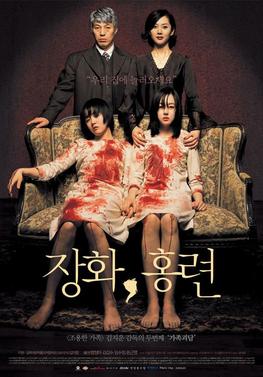
The official poster for the film 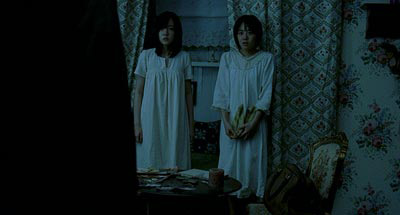
Su-mi and Su-yeon (Left to Right) 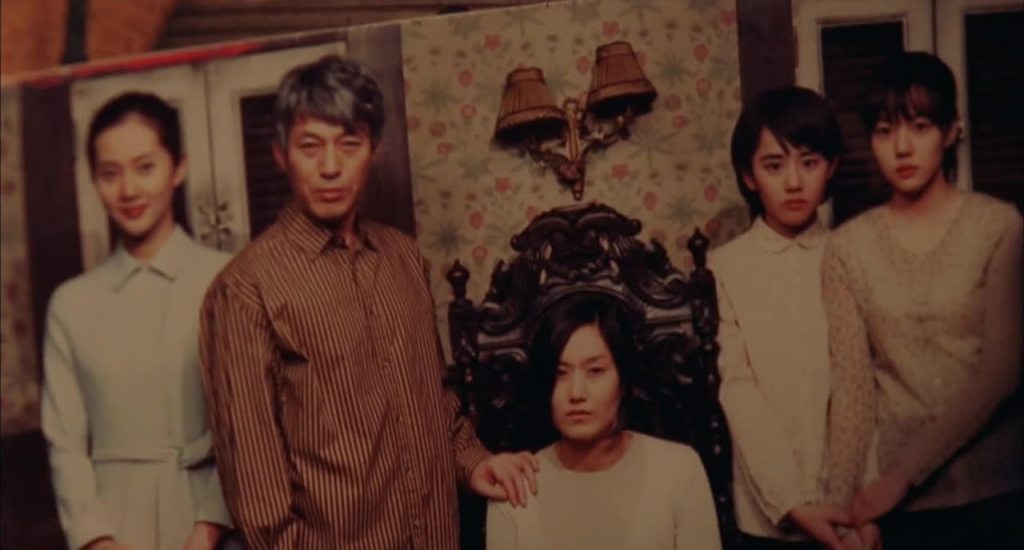
A family picture. Eunjoo, their father, their late mother, Su-yeon and Su-mi (from the left)
References
Elley, D. (2003, July 03). A tale of two sisters. Retrieved May 21, 2021, from https://variety.com/2003/film/reviews/a-tale-of-two-sisters-1200540710/
Hangul Celluloid: A tale of two SISTERS (2003 South Korea) Review. (n.d.). Retrieved May 21, 2021, from http://www.hangulcelluloid.com/taleoftwosisters.html
Poinsecurra. (2015, April 24). A tale of two sisters. Retrieved May 21, 2021, from https://screengrabsaz.wordpress.com/2014/09/21/a-tale-of-two-sisters/
 Cinema of the Wave